






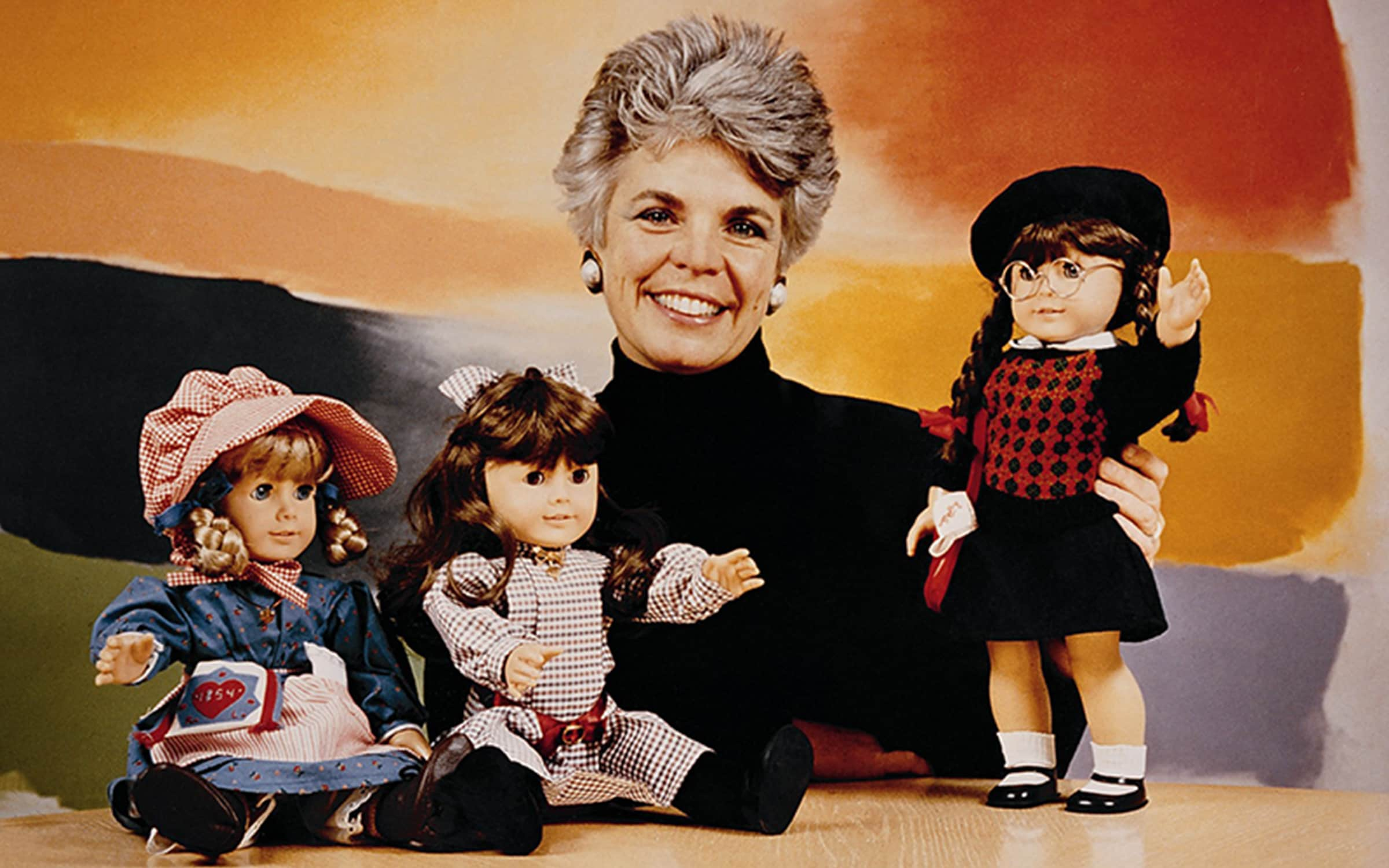
American Girl founder Pleasant Rowland, a reading teacher and curriculum developer, created American Girl’s dolls and stories with one guiding mission: to show girls that they are part of a long line of strong, smart, confident, and courageous women who have had an important role in the creation of this country and the future of this world.
Classic American Girl dolls and stories portray history for kids in a fun, diverse, and engaging way that encourages meaningful connection between girls and their grownups. Our historical characters were the heart of Pleasant’s original idea, inspired by remembrances handed down by the women in her own family.
“When I looked back at my ancestors and all the women who had come before, I saw that so much of what I thought was important in my own life had been important all through their lives as well. What I think American Girl really does is give mothers and daughters and grandmothers a chance to connect, as my mother and grandmother had with me in a simpler time of childhood.”—Pleasant Rowland
Historical AG dolls and stories celebrate the timeless feelings and cherished traditions of childhood. The universal truths of joy, sorrow, compassion, disappointment, and hope span across time. And throughout time, girls have loved family and friends, struggled to find the courage to do what is right, and found ways to make a difference in their own way. The task of becoming who they truly are and learning how to use their unique talents is the same as it ever was.
Our enduring focus on education means our American Girl historical characters spark conversations: learning from our country’s past helps a girl understand where she came from. We hope a girl will go to her mother or grandmother and say, “This character is the same age as you. What was your childhood like?” By learning from our country’s past, by sharing our opinions and experiences, we find deeper understanding. Through relatable characters and authentic experiences, our historical dolls and stories help inspire curiosity about different time periods and diverse traditions that help girls think about what kind of people they want to be.

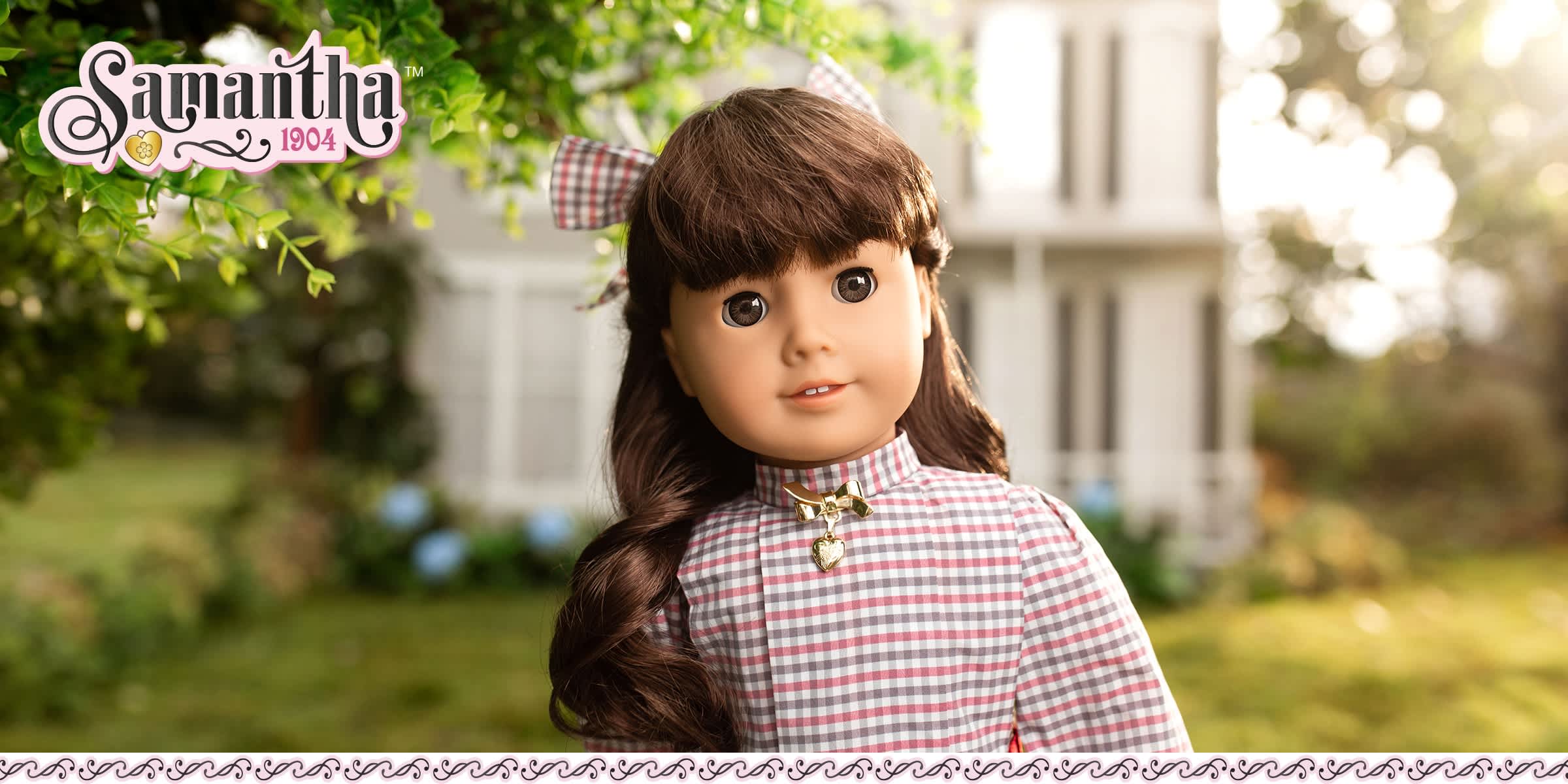
Samantha Parkington™
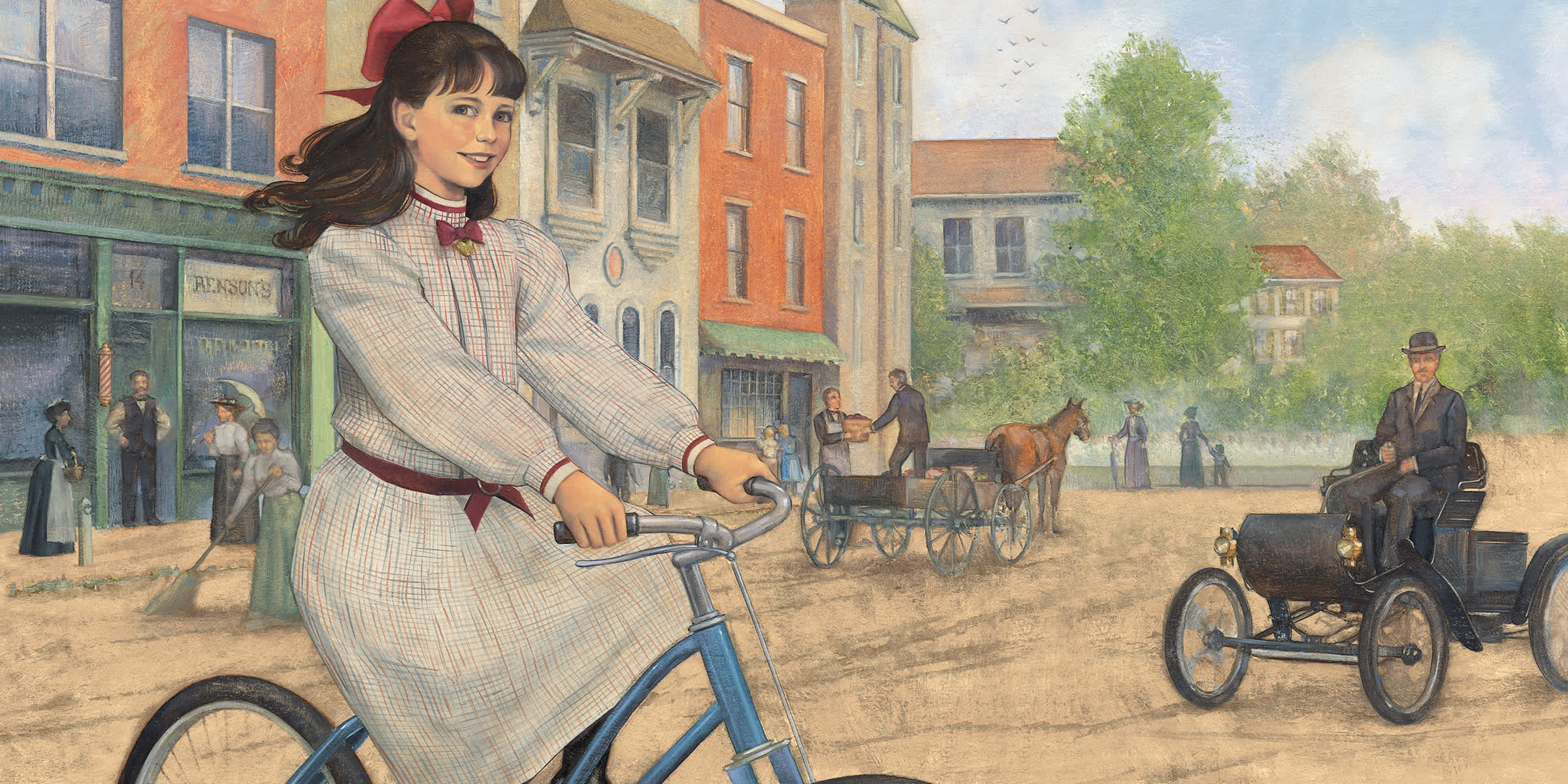
Samantha is a plucky orphan growing up in 1904 who finds family in the people around her: Grandmary, her strict but loving Victorian grandmother; her doting and dashing Uncle Gard, who loves newfangled inventions—especially motor cars; her Aunt Cornelia, whose progressive ideas challenge Grandmary’s long-held beliefs about how “proper young ladies” should think and act; and Nellie and her sisters Bridget and Jennie, servant girls who join Samantha’s family after she helps them escape a cruel orphanage. The people in her family, all with different points of view, separate class distinctions, and diverse cultural backgrounds and life experiences, discuss their thoughts and ideas openly and respectfully. They give Samantha a wide range of perspectives to consider, and the space to choose a path of her own.
Curiosity and conscience
As a result, although Samantha lives a genteel life of upper-class comfort, she is a resilient, independent thinker who is willing to question and push against social boundaries. When faced with a decision, whether minor or momentous, Samantha lets her curiosity and conscience lead her actions. She speaks her mind, unafraid to state an inconvenient truth or tread into forbidden territory. When Nellie tells Samantha the truth about why factories make goods so fast and cheap, Samantha learns that her view of “progress” is made possible by the young children forced to work in factories that pay them meager wages, operate unsafe machines that hurt them, and produce polluted air that makes them sick.
Samantha’s response to this newfound cultural awareness is immediate and powerful, fueled by her sense of empathy. She changes the speech she had prepared about “Progress in America” and surprises everyone, especially Grandmary, when instead she says: “If our factories can hurt children, then we have not made good progress in America. And I believe Americans want to be good. I believe we want to be kind. And if we are kind, I believe we will take care of the children. Then we can truly be proud of our factories and our progress.”
Agent of change
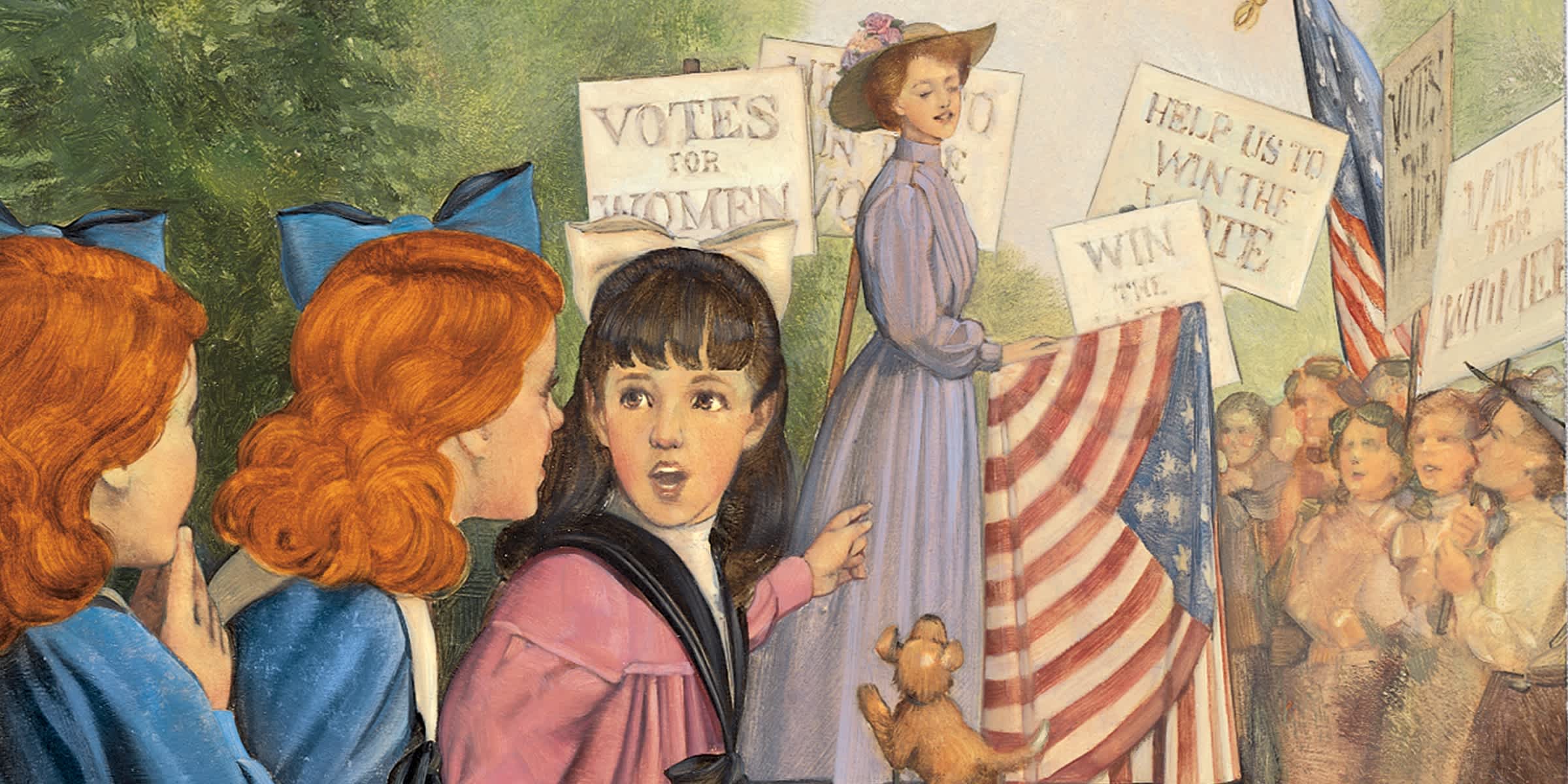
Samantha continues to grow and expand into the grownup world as she learns more about women’s suffrage. When Samantha and Grandmary arrive in New York City to visit Cornelia and her twin sisters Agnes and Agatha, Samantha notices a group of women in Madison Square Park. They carry signs saying, “Women, Fight for Your Right to Vote,” and “Now Is the Time for Change.” Grandmary dismisses the scene and the “newfangled notions,” but Samantha is fascinated.
Later in the day, the girls discover Cornelia in Madison Square Park, giving a rousing speech in favor of women’s right to vote. Turns out Grandmary has heard the speech, too, and she experiences some surprising growth herself: “You and the other ladies who spoke today were simply saying that women should stand up for what they think is right,” Grandmary says. “That’s exactly what I believe, too. And if that’s what voting will give us a chance to do, then I think women should vote. The time for change has come…”
Shared stories
Samantha, perhaps more than any other American Girl character, captures the power of women’s shared stories connecting across time: from Grandmary to Samantha’s mother, Lydia, whose story Samantha courageously convinces Grandmary to tell; from Cornelia’s role in advancing women’s suffrage to Samantha’s own confidence in standing strong for her beliefs.
And for the first time, Samantha’s story continues through our Girl of the Year 2026 character: Raquel Reyes. Raquel is Samantha’s great-great-granddaughter.
While at a family reunion and wedding, Raquel is eager to share traditions from her dad’s side of the family—like making paletas and getting people dancing to her favorite Mexican tunes. After she discovers her great-great-grandmother Samantha’s diary hidden away in the attic of her childhood home, she learns more about the history of her mom’s side of the family. She learns that Samantha loved peppermint ice cream, so Raquel and her cousin Sloan make mint chip paletas in her honor.
Later, when Sloan shares her doubts about belonging in the family because she was adopted, Raquel shows empathy by sharing Samantha’s story of being raised by Grandmary, and then her Uncle Gard and Aunt Cornelia. She reassures Sloan that families have always been formed in different ways, and that it’s really love and support that defines a family.
Meaningful connections
Draw on these key moments from Samantha’s stories about empathy, resilience, and cultural awareness to inspire educational conversations that connect you with your daughter:
• Just like Samantha’s, families today can look different for everyone. Some kids live with one parent, some live with grandparents, some live with blended families, and some consider friends to be a part of their family, too.
• Compassion, generosity, and standing up for the less fortunate remain aspirational qualities for girls and people of all ages—now more than ever.
• Technology continues to advance rapidly. New inventions, such as smartphones, AI, and social media, change the world around us, as cars did in Samantha’s time. It’s important we stay aware of the benefits and shortcomings of new technologies.
• Child labor still affects nearly 138 million children worldwide, but dedicated people in organizations such as Save The Children are striving to end it.

Learn more about Samantha’s character and era
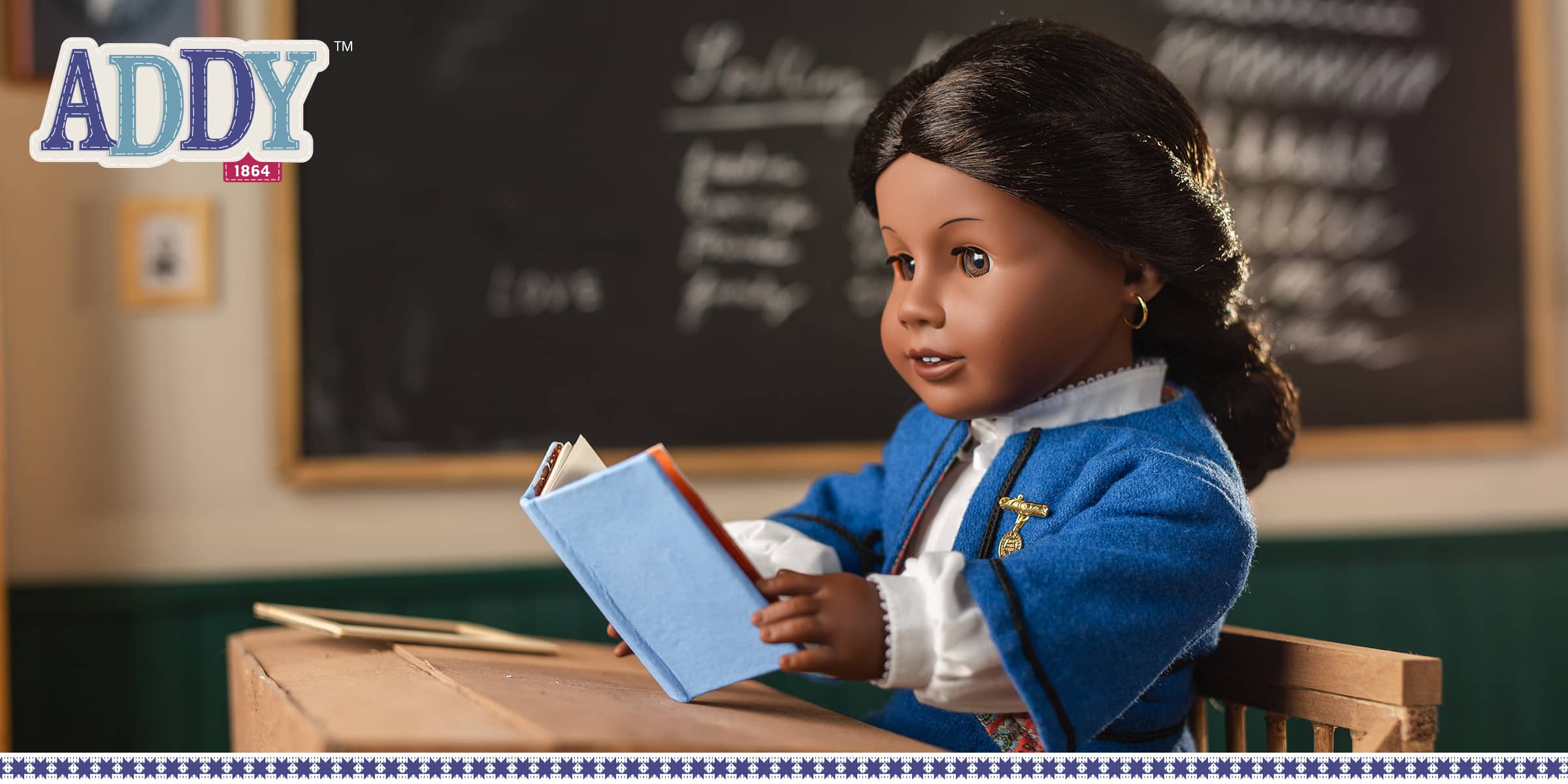
Addy Walker™
Addy is a smart, strong, courageous girl growing up amid the Civil War, helping to reunite her family in freedom. As author Connie Porter recalls, “I wanted children to see Black people as part of strong, loving families. Even slavery cannot dim the love and light Addy carries for her family in her heart.” When slavery tears Addy’s family apart—just as the nation was divided by the Civil War, North against South—Addy perseveres and never loses hope that they will be together again one day.
Much loved
The cowrie shell necklace Addy wears is a powerful symbol of her family’s resilience and Addy’s unending connection to the people in her past. During their escape from the plantation in North Carolina to freedom in Philadelphia, Momma strings the shell on an old shoelace that once belonged to Addy’s brother Sam, so Addy will have something to remember him by. Momma tells Addy that the shell belonged to Addy’s great-grandmother, who was stolen from West Africa when she was a girl. Her name was Aduke, which means “much loved” in Yoruba, a language spoken by the Yoruba people living in modern-day Nigeria, Benin, and Togo. “I saved her name for you, Addy,” Momma said. “Her journey ended in slavery. Yours, girl, is taking you to freedom.”
The importance of education
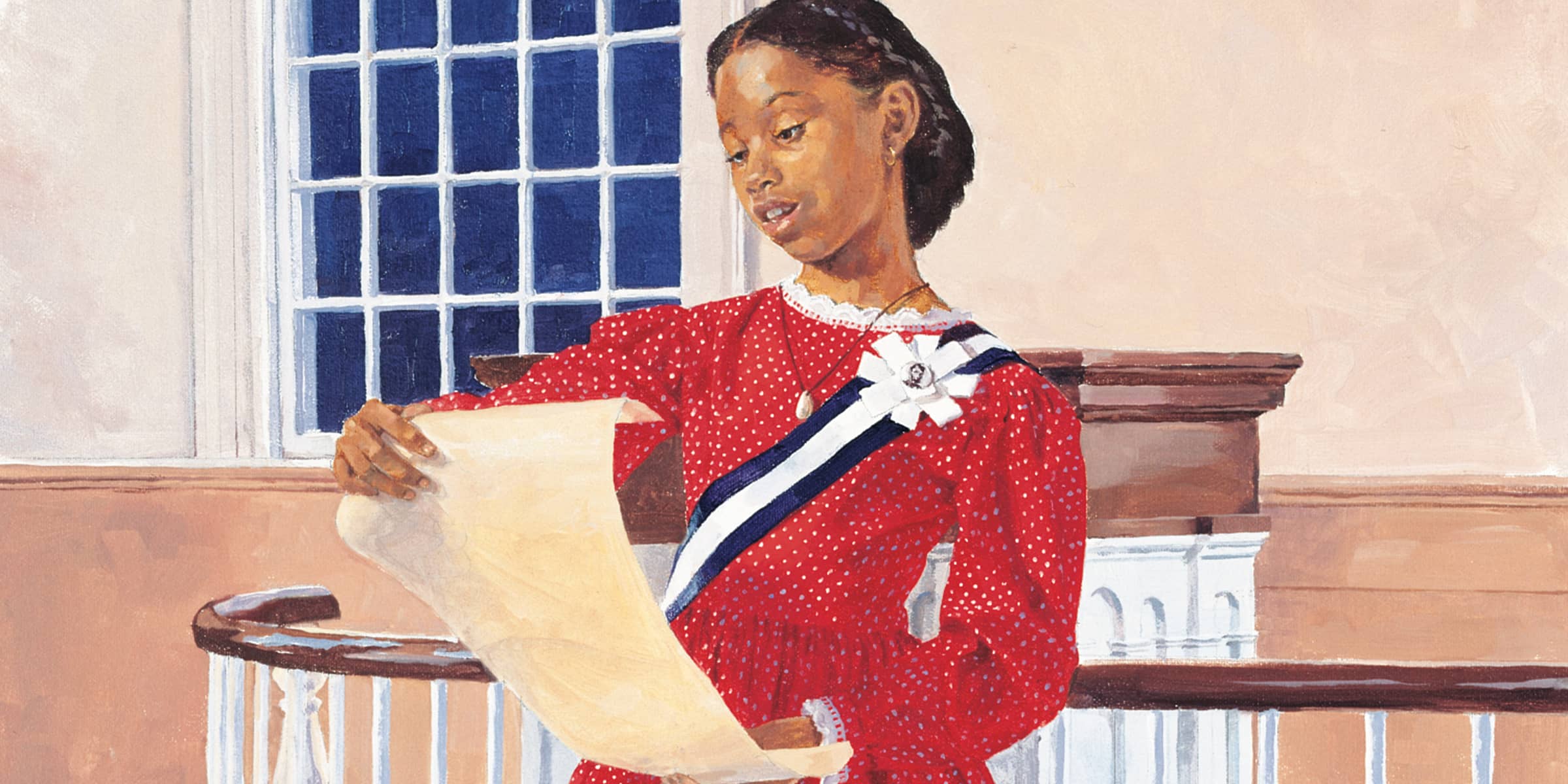
Once Momma and Addy reach Philadelphia, Addy makes her first friend: Sarah Moore, whose empathy and welcoming nature help Addy feel at home in this big, strange city. Just as important, Sarah helps Addy manifest her deeply held desire to learn to read. After Sarah and her mother, Mabel Moore, help Momma find work as a seamstress, Momma makes enough money that Addy can work part time and go to school with Sarah.
Later in Addy’s series, she discovers that Sarah’s family is struggling financially, so much so that Sarah has to quit school to work full time so she can contribute to her family’s income. Addy’s empathy moves her to make an appeal to Sarah’s mother, offering her delivery job to Sarah so she can have all the tips. Sarah’s mother thanks Addy but sadly tells her that it still won’t be enough money. Undaunted, Addy gives Sarah a new slate for Christmas and tells her friend, “Don’t give up hoping, Sarah. Maybe one day you can come back to school. But even if you can’t, I can help you keep up with our lessons.”
Author Connie Porter shares, “Writing about Sarah having to leave school was emotional for me. Having grown up poor, one of nine children, I very much knew that in order to escape poverty, I needed to be educated. My parents, who grew up in the segregated South during the Great Depression, knew this and encouraged me and my siblings to pursue education.”
Freedom’s got its cost
The longer Addy lives in Philadelphia, the more her cultural awareness of the racism around her grows, and the more she realizes that freedom isn’t everything she thought it would be. Addy can’t ride inside the streetcars, certain shopkeepers won’t wait on her or even let her in their stores, and her father can’t find a job that utilizes his skills as a carpenter—only his back for lifting crates and hauling ice.
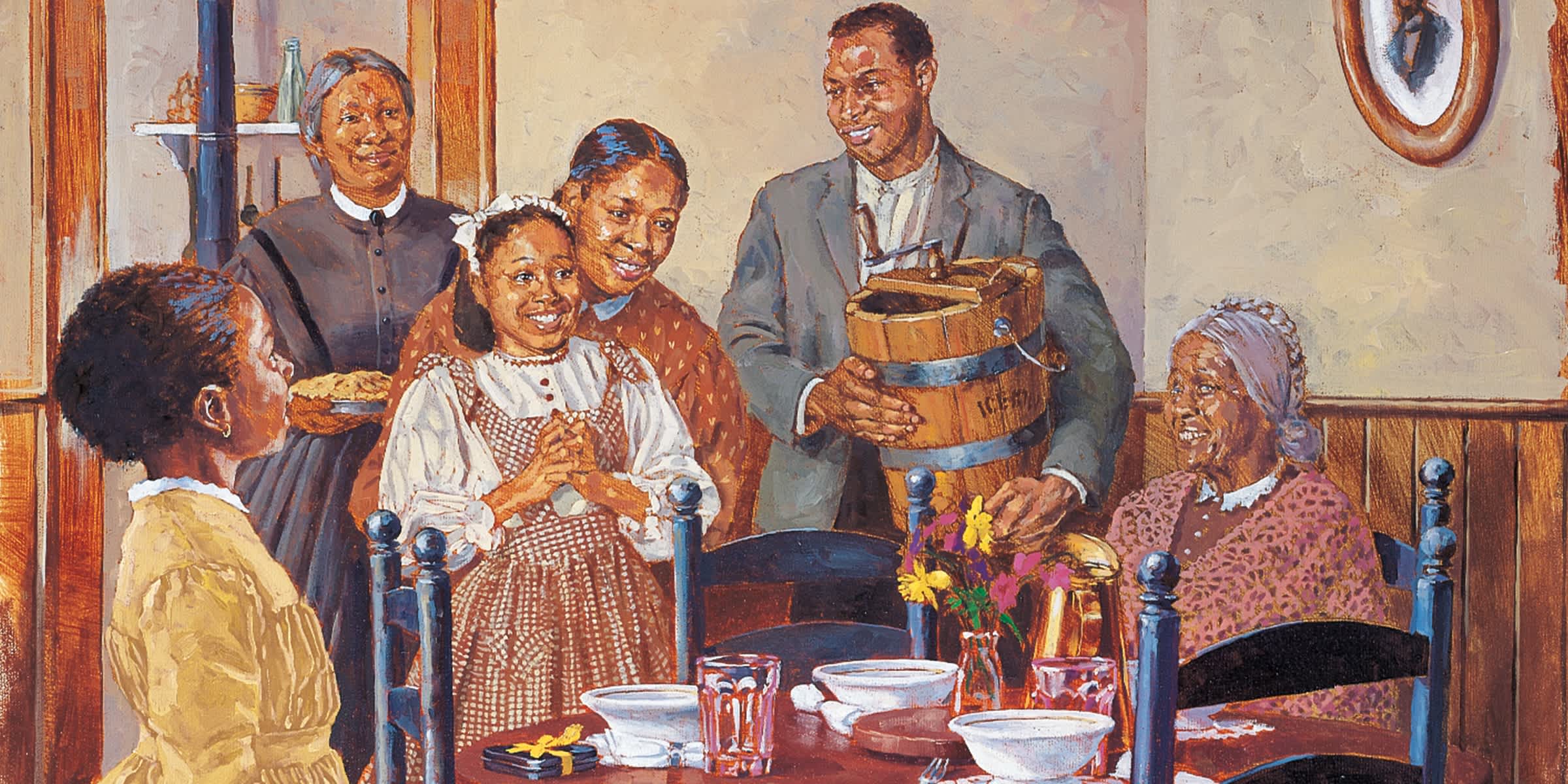
Addy’s family has been forever changed because of slavery and the war: her brother Sam loses an arm while fighting to be free, and her baby sister, Esther, barely knows Addy when she finally reaches Philadelphia with Auntie Lula. When Uncle Solomon and Auntie Lula die, Addy despairs that her dream of having her whole family together in freedom can never come true. Momma comforts Addy by lifting the cowrie shell on Addy’s necklace and helping her remember the resiliency of her family: “This shell was to remind you that we are linked to the people in our past forever. They live in our hearts. Their lives, and their strength and courage, are part of us even though they are gone.”
Meaningful connections
Draw inspiration from the lessons of empathy, resilience, and cultural awareness in Addy’s stories to have educational conversations that deepen your connection with your daughter and help her better understand the lessons of the Civil War and the slavery experience:
• Even today, the fight for racial justice continues. Black people are more likely to face unfair obstacles, like not having the same opportunities at school or being treated more harshly by the justice system.
• Addy’s story teaches kids about slavery, a painful part of history. Learning about it is important, as it helps us ensure that we never repeat our mistakes and that we create a better future for all.
• Black communities and churches are sources of joy and pride just as they were in Addy’s time.

Learn more about Addy’s character and era
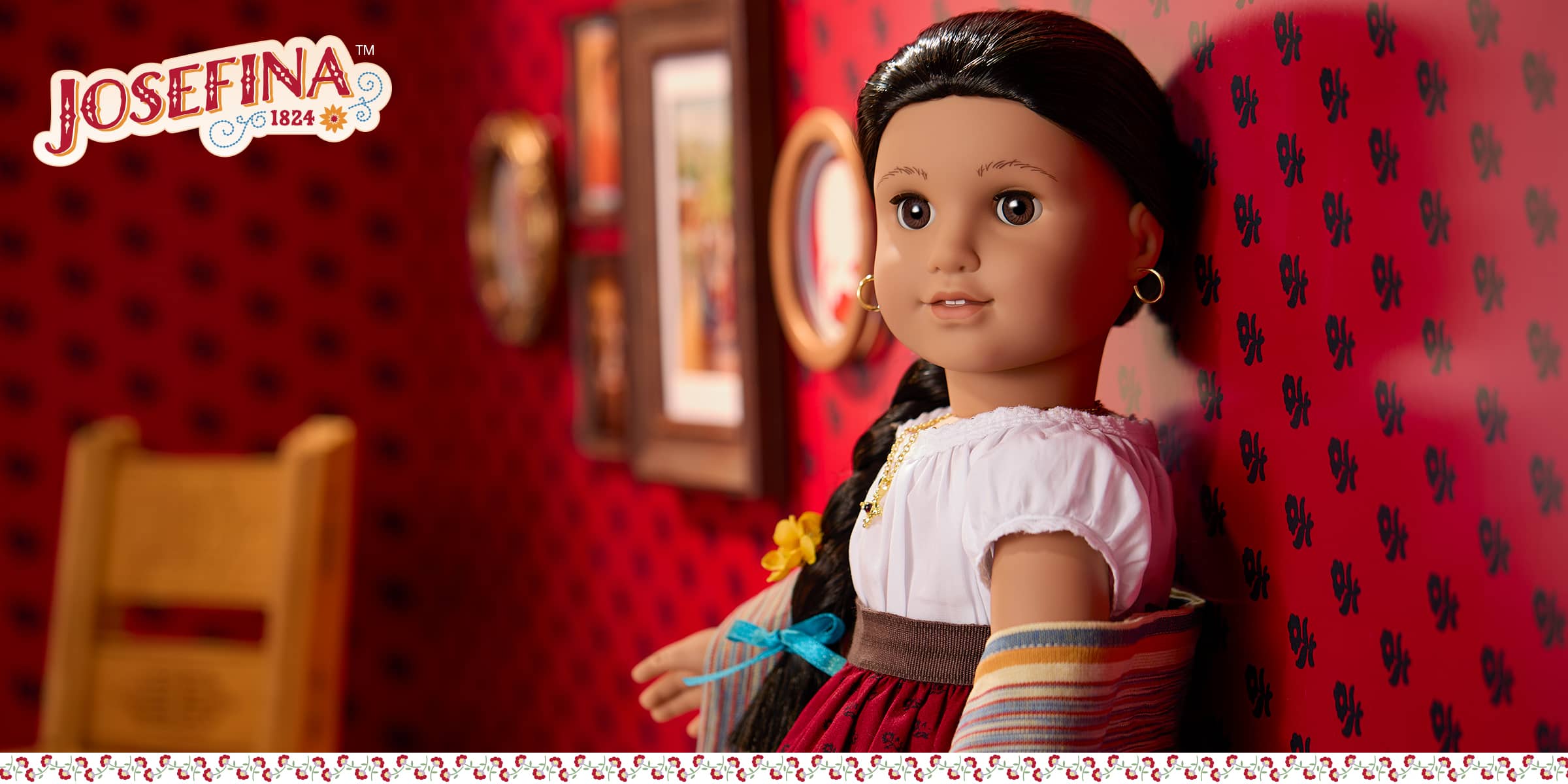
Josefina Montoya™
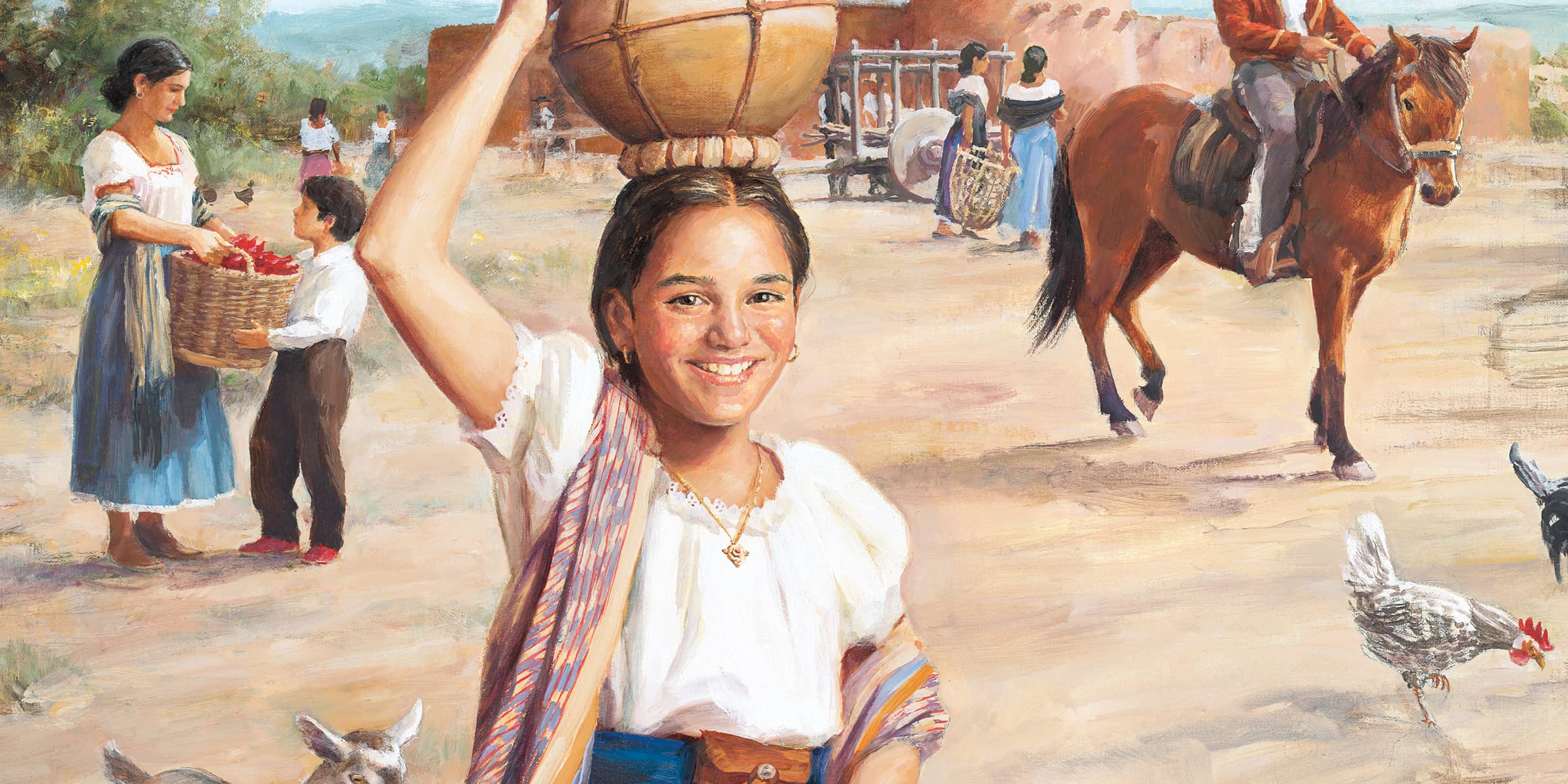
Josefina is a girl filled with heart and hope living on a rancho in beautiful New Mexico at a time of great change for her family and her culture. As her story opens, she and Papá and her sisters are trying their best to carry on after the recent loss of Mamá. Josefina’s quest for healing—for herself and her family—drives her stories: Josefina finds heartfelt and joyful ways to remember Mamá as she helps her family and the rancho move forward into a new future.
Honoring old and new
Josefina’s stories are set in 1824—when New Mexico was part of the country of Mexico, which had just won its independence from Spain. Josefina’s cultural awareness of her Pueblo neighbors comes from personal relationships carefully cultivated over generations. Josefina often accompanies her father to a nearby Pueblo village when he visits his longtime trading partner, Esteban, who has a granddaughter named Mariana. She and Josefina have been friends since they were little.
The timing of Josefina’s stories also includes Josefina’s growing knowledge of the first americanos, or “Yankee” traders, who traveled west from Missouri along the Santa Fe Trail. When Josefina unexpectedly meets her first americano, a scout named Patrick O’Toole, on a hilltop near her grandfather’s rancho, she politely greets him and guides him to meet her family. After Abuelito and Papá deem Patrick trustworthy, they arrange for him to trade Papá’s mules to the americanos on Papá’s behalf. Josefina and her community are living through the first contact of these two worlds—worlds that will soon profoundly change one another.
Change can be good
Although Josefina’s family sometimes resists new ways of doing things, Josefina helps them build resilence and see that new ways can be good. When Josefina’s grandfather arrives from Mexico City with his trading caravan, he brings a surprise that will soon change all their lives: their mother’s sister, Tía Dolores, who introduces new ideas and fresh ways of doing things. When Papá agrees with Tía Dolores’s idea of teaching the girls to read and write—something Mamá did not know how to do—it’s the last straw for Josefina’s sister Francisca. She refuses to learn to read and write because she believes all Tía Dolores’s changes are making them forget Mamá. Josefina doesn’t want to believe this is true, and yet a deep fear starts to grow within her as she wonders if Francisca is right. Is learning to read and write disloyal to Mamá?
Bit by bit, Josefina realizes she is forgetting Mamá’s poems, songs, and prayers, which she once knew by heart. Tía Dolores soothes Josefina’s heartache and encourages her resilience with a treasure she keeps hidden in a secret compartment of her writing desk: a little book, bound in soft brown leather. As Josefina turns the pages, she stops at a drawing of four white doves. Tía Dolores reads the words that Josefina feared she had forgotten, a poem Mamá loved about four white doves, representing Josefina and her three sisters:
Behold four little white doves
perched on a rosemary bush.
They were saying to each other,
There’s no love like the first love.
Later in Josefina’s series, she is able to open her heart to the idea of Tía Dolores becoming another mother for her and her sisters, and a new wife for Papá. Josefina helps her family see that Mamá will always be their first love, and they also have room in their hearts for new love.
Becoming a healer
There is one character in Josefina’s stories that she finds very hard to love: Florecita, the meanest, bossiest goat in the herd. Josefina, usually so filled with empathy for both people and animals, regards Florecita as her nemesis. The goat pokes Josefina with her horns, knocks her down, and eats the primroses she has gathered in honor of Mamá. Later, Florecita gobbles up a beautiful bouquet Josefina made for Tía Dolores. When the goat eats the flowers in Mamá’s precious garden, Josefina’s anger becomes greater than her fear, and she stands up to Florecita for the first time.
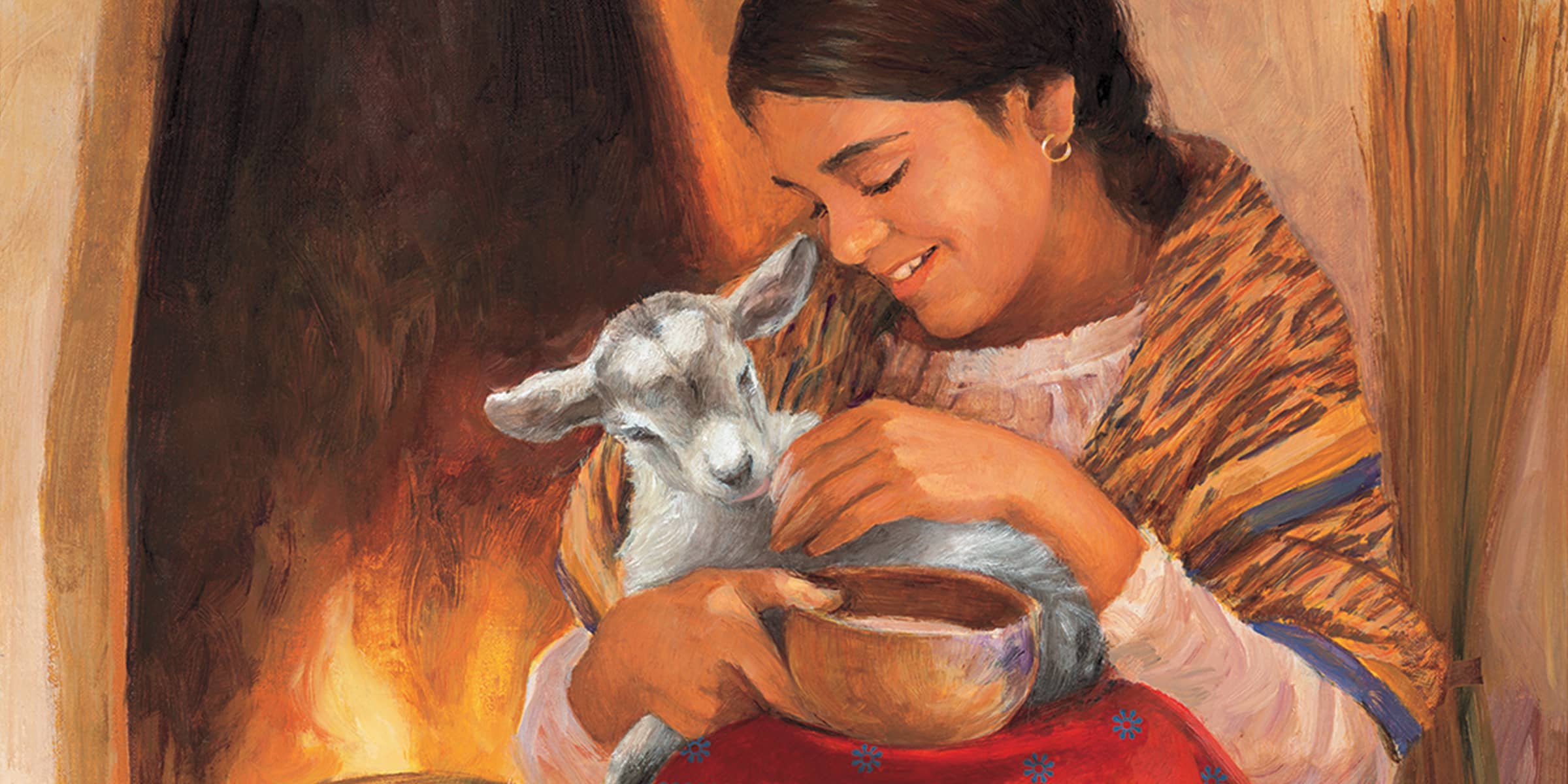
Nowhere does Josefina’s strong sense of empathy come through more clearly than in the scene where Florecita is giving birth. The goat is in trouble. As Josefina looks down on her enemy, watching her breathing grow slower and weaker, she feels sorry for Florecita and is filled with compassion. When Florecita dies, the fear Josefina has felt for so many years passes away, too.
With every ending comes a new beginning; in this case the sweet arrival of Sombrita, Florecita’s orphaned baby goat. Josefina wants to care for Sombrita, but Papá worries that the tiny goat may not survive, and that Josefina’s tender heart will break. Josefina is sure in her answer: “When any of God’s creatures is sick or weak we have to try to make it better, don’t we?” As she holds out her arms for the little goat, Josefina’s journey toward becoming a curandera—a healer—begins.
Meaningful connections
Bring the inspiring messages of empathy, resilience, and cultural awareness from Josefina’s stories into your own family by fostering educational conversations that deepen your connection with your daughter:
• Love of family, community, and traditions offer great comfort and help the recovery and healing from personal loss, just as it did in Josefina’s time.
• Just like Josefina, we are living in a time of rapid change, with constant social and technological changes. Though change can be scary, it's a reminder to stay grounded in what's important to us, such as friends, family and community.
• Just like in Josefina’s time, many families today move to new places to build better lives. Josefina’s stories remind us that welcoming new people and learning from one another makes our communities stronger.

Learn more about Josefina’s character and era
Melody Ellison™
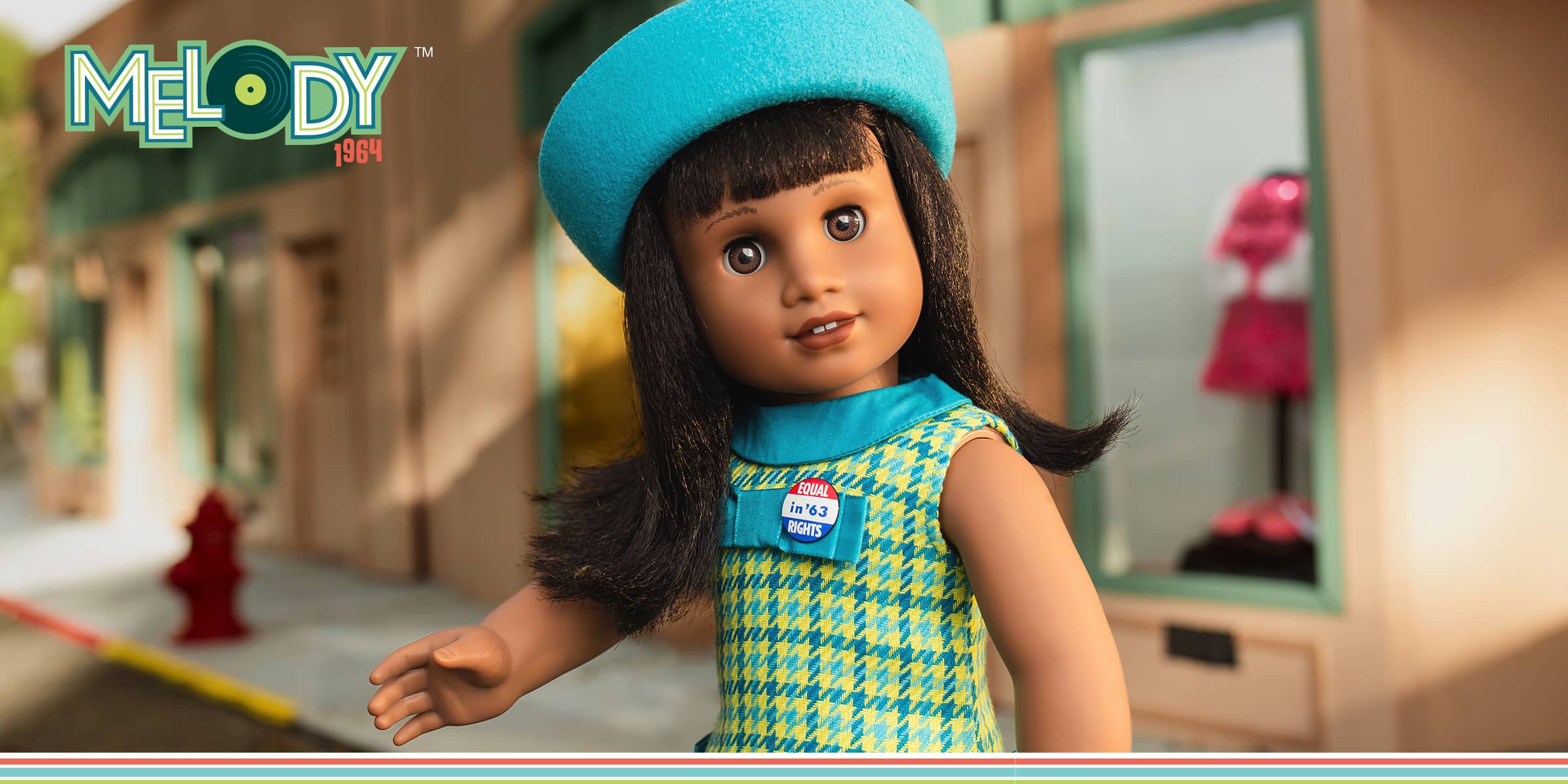
Melody is growing up in 1964 Detroit, at the height of the civil rights movement. Her stories encourage a passion in girls today for fairness, justice, and equality—themes that were everywhere in Melody’s time—from dinnertime conversations to the news on TV to the music on the radio. Melody’s world is filled with all kinds of music, from gospel to Motown. Whether she’s in the choir at church or singing into a hairbrush with her sisters, Melody loves to add her voice to others’ and hear the sound of perfect harmony.
Reading the signs
Not everything in Melody’s world is harmonious, however. Through her stories, Melody gains cultural awareness of the racism and discrimination against Black people all across the country and in her hometown of Detroit. Melody’s grandparents, who were born and raised in Alabama, tell her that in the South racism is often easy to see: there are “Whites Only” signs on shops and restaurants, on train cars and in waiting rooms. Bathrooms and drinking fountains are labeled either “White” or “Colored.”
Although there are no “Whites Only” signs in the North, Melody’s family has keen cultural awareness of the racism and discrimination that run barely beneath the surface in Detroit. Melody attends a segregated school for Black children that has fewer supplies than schools for white children. Her cousin’s family, newly arrived from Birmingham, are given a hard time when they try to buy a house. Black families were discouraged or blocked from buying houses in areas of town where white people lived, although those rules often weren’t written down or spoken aloud.
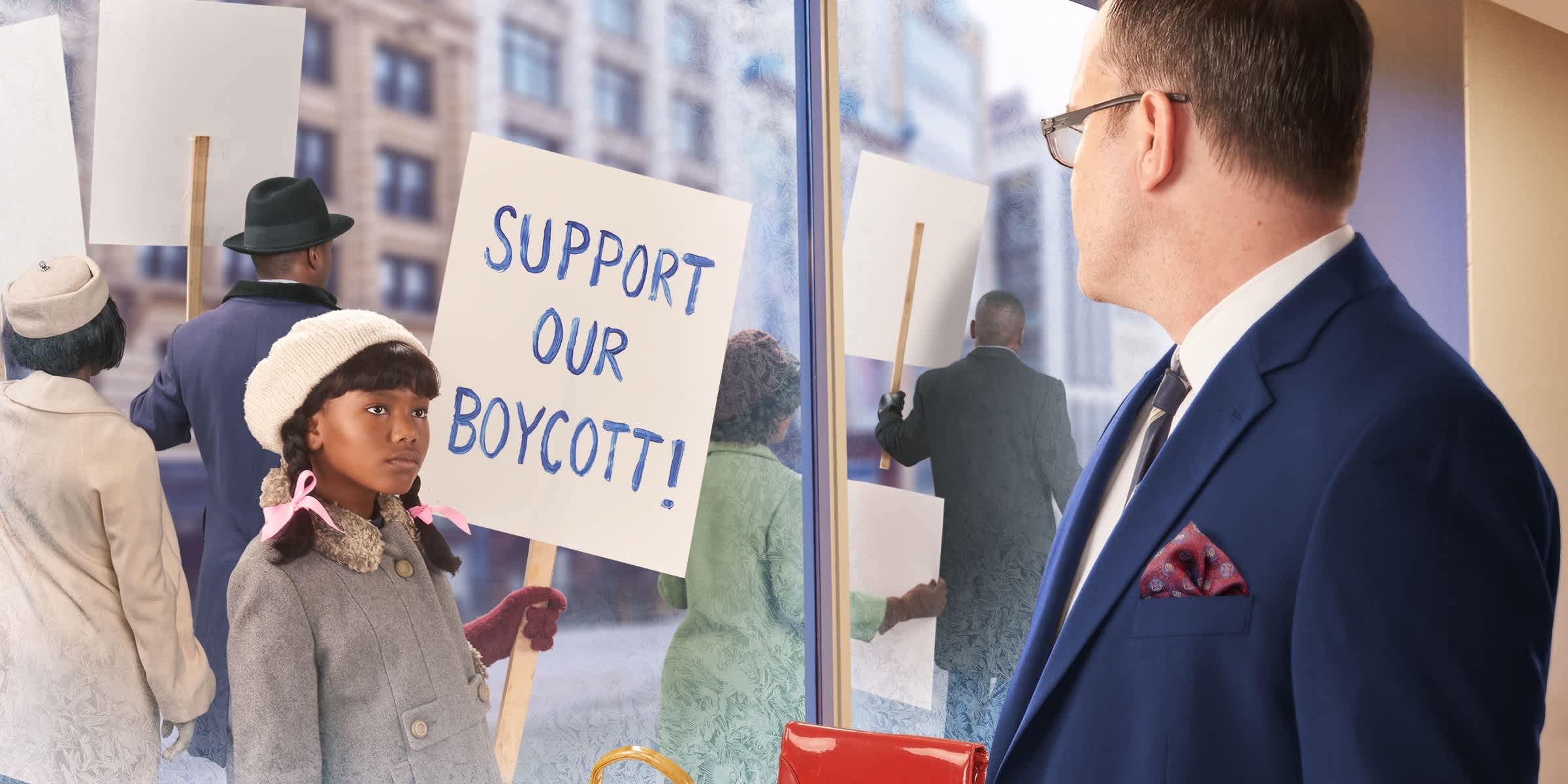
Black people in the North could also be refused service in hospitals, restaurants, and stores. When Melody accompanies her older brother Dwayne to shop for a new suit for his Motown audition, the clerk accuses them of shoplifting and throws them out of the store. Melody feels shaken—this is something that’s never happened to her before. Unfortunately, it’s not the first time it’s happened to Dwayne. He’s more determined that ever to become a famous Motown star, in hopes that no one will ever treat him this way again.
Standing up
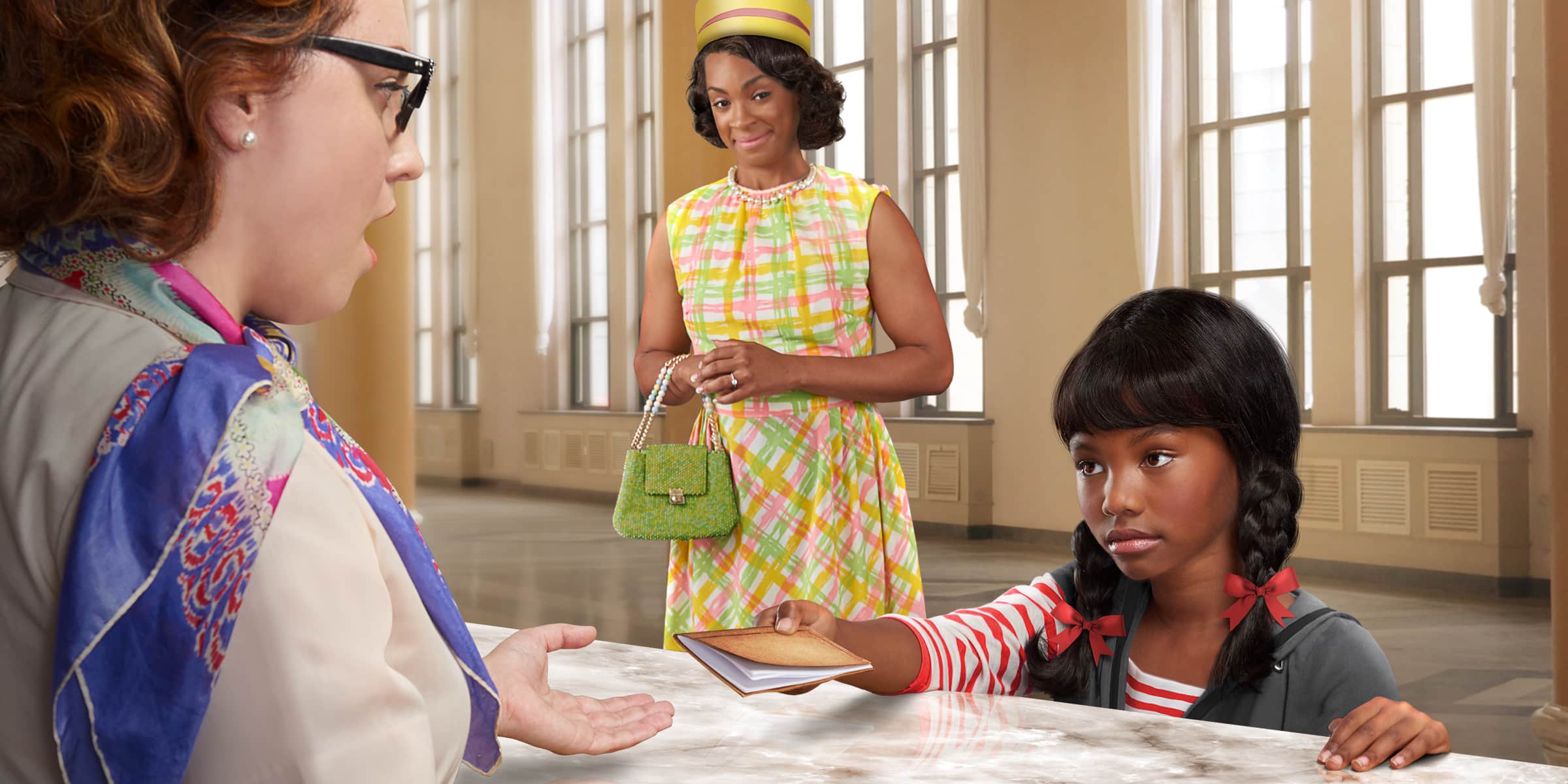
Melody feels empathy when her older sister, Yvonne, tells her she was refused a job at their local bank. Yvonne says it’s because she is Black, and Melody doesn’t want to believe what she’s hearing. Surely all the jobs must be full? But when Yvonne tells her a white girl went into the manager’s office after she did and the manager told her there were still several positions open, Melody’s empathy turns to outrage, and she takes action.
The very next day, Melody walks into that same bank to stand up for her sister and for making things fair. Melody summons all her courage as she says to the bank teller: “My sister is really good with money and numbers, but this bank wouldn’t let her apply for a summer job because she’s Black. That’s not fair.” When the teller asks Melody if she’s sure she wants to withdraw all her money, Melody continues with confidence: “This bank discriminates against Black people. I don’t want to keep my money here anymore.” Melody’s mother is proud of her and tells Melody that money has a voice, and what she chooses to do with it says a lot about her beliefs.
Marching on
When Melody’s family learns that Dr. Martin Luther King Jr., a young preacher gathering fame for his powerful speeches about nonviolent activism, would lead a march and give a speech in Detroit, they want to hear what he has to say. The march is called the Walk to Freedom, and it was the first time Dr. King gave his “I Have a Dream” speech, even before he delivered it at the March on Washington. Melody makes signs with her sister Yvonne: Freedom Forever! Justice for All! Fair Housing Now! Separate is not Equal!
On the day of the March, thousands of people turn out—many more than predicted. Mommy takes Melody’s hand, and her grandmother takes Melody’s other hand. Walking between her mother and her grandmother, raising her girl voice with theirs, Melody feels the resilience of her family and of everyone around them. All the other voices surrounding them are like hearts beating together. This is harmony, Melody thinks.
Singing out
Melody’s sense of safety is badly shaken when a church bombing in Birmingham kills four young girls. It is no accident—some people aren’t happy about Black people fighting for equal rights. They think bombing a church will scare Black people so much that they will stop marching and protesting and speaking up. Melody is devastated. How can something so horrible happen at a church? The tragedy makes her afraid to go to her own church, and it leaves her unable to sing or even to speak.
Melody tries to find the resilience to return to church and sing. Maybe she can do this for the four girls who will never speak again. Maybe she can lift her voice and sing with empathy, just for them. When she walks into church hand-in-hand with her friends, Melody thinks, We’re four little girls. Drawing on their collective strength, Melody refuses to be silenced by fear and instead lifts her voice in honor of those who died, as well as those who continue to fight for equality:
Lift every voice and sing,
Till earth and heaven ring,
Ring with the harmonies of liberty…
Meaningful connections
Celebrate the messages of empathy, resilience, and cultural awareness in Melody’s stories by prompting educational conversations that deepen your connection with your daughter and help her better understand the lessons of the civil rights movement:
• Social justice is as relevant today as it was in the 1960s. While progress has been made since Melody’s time, unfairness still exists today in our schools, communities, and how people are treated based on where they come from or what they look like.
• Girls as young as Melody stand up for what they believe in and can make meaningful change. Community leadership is for every age.
• All people, no matter their age, race, or culture, can use their voices to speak out about what they believe in.

Learn more about Melody’s character and era
Julie Albright™
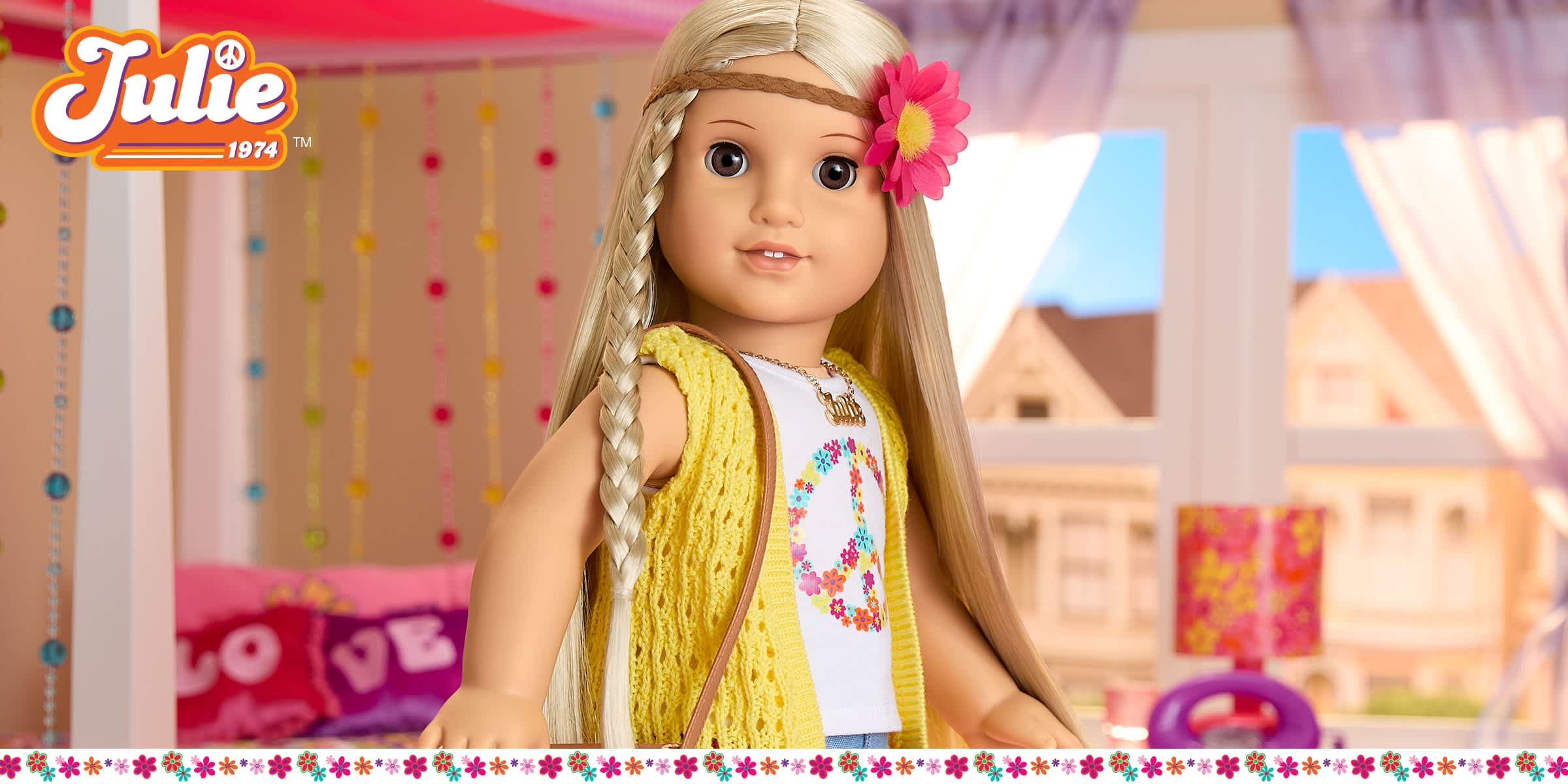
Julie is a fun-loving, optimistic girl growing up in San Francisco in the 1970s, standing up for girls’ rights and working to make a better, more inclusive world for everyone. She is the first American Girl character whose family is going through a divorce, mirroring the political divisions in the country at the time. Throughout her series Julie learns that when rules needs updating or attitudes need rethinking, sometimes you have to start the change yourself.
A friend always
Julie’s story opens with Julie getting ready to move from her family’s home to Mom’s new apartment across town in the Haight-Ashbury neighborhood. Her best friend, Ivy Ling, has come to say goodbye, showing empathy for the nervousness and sadness her friend is feeling. Julie will still come to stay at Dad’s house on the weekends, so it’s not goodbye forever, but the girls know it won’t be the same.
Ivy lives across the street from Julie’s house, and she assures Julie that she’ll take good care of Nutmeg, Julie’s floppy-eared rabbit, when Julie’s dad, a pilot, is away from home. To help Julie remember that their friendship will stay the same even though so much else is changing, Ivy gives Julie a new friendship bracelet with red and purple beads, their favorite colors. Just before Julie has to go, Ivy picks up a marker and writes the letters A.F.A. on the toe of Julie’s sneaker: A Friend Always. The two girls hook pinkies in a secret handshake they’ve had since kindergarten, and neither girl wants to be the first to let go.
Starting over
Julie does her best to summon resilience on her very first night in her mother’s new apartment. They live above her mother’s new business, a store called Gladrags that sells handmade crafts and secondhand clothes. Julie’s proud of her mom’s new business, and she asks her mother to help her decorate her new room. They plan to make curtains and decorate a lampshade, and when Mom suggests a fuzzy rug in the shape of a foot, Julie agrees it would be perfect.
Julie feels less resilient about starting a new life at a new school, in a new neighborhood, and making new friends. Julie’s mother feels empathy for her daughter and shares a story Julie’s never heard before, about a time when Julie’s grandfather moved his family to France for a year. Mom could barely speak French, and it took a long time to make friends. “Look,” says Mom, “I know starting over in a new place is scary. It’s scary for me, too, starting a new business. But sometimes you just have to trust in yourself and take a chance.”
Rebounds
On her first day in her new school, the only kid who talks to Julie all day is the boy who sits next to her in class. His name is Thomas Jefferson, like the president, but he goes by T.J. When Julie and T.J. start playing basketball after school, T.J. says Julie’s just as good as most of the boys, and he encourages her to sign up for the school team.
But the basketball coach won’t let Julie join the team, saying it’s for boys and boys only. Julie is incensed at the unfairness! She shows resilience by not taking no for an answer. When she tells the coach he has to let her play because of Title Nine, a new federal law that forbids unequal treatment of boys and girls, he still says no. Undaunted, Julie gets 150 signatures on a petition to let her play and takes it to the principal. The principal and the school board support Julie, and she becomes the newest player on the Jack London Jaguars basketball team.
New beginnings
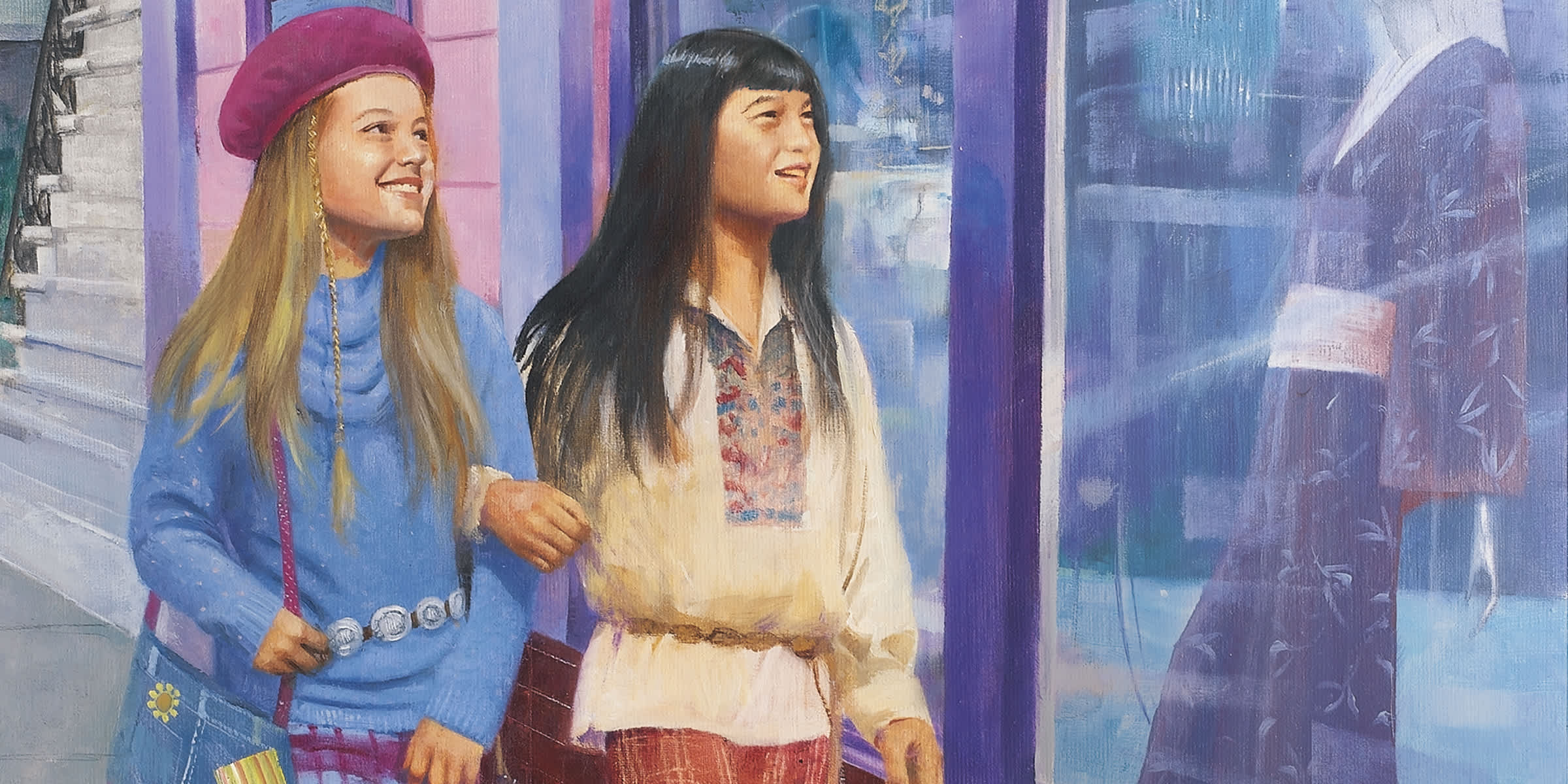
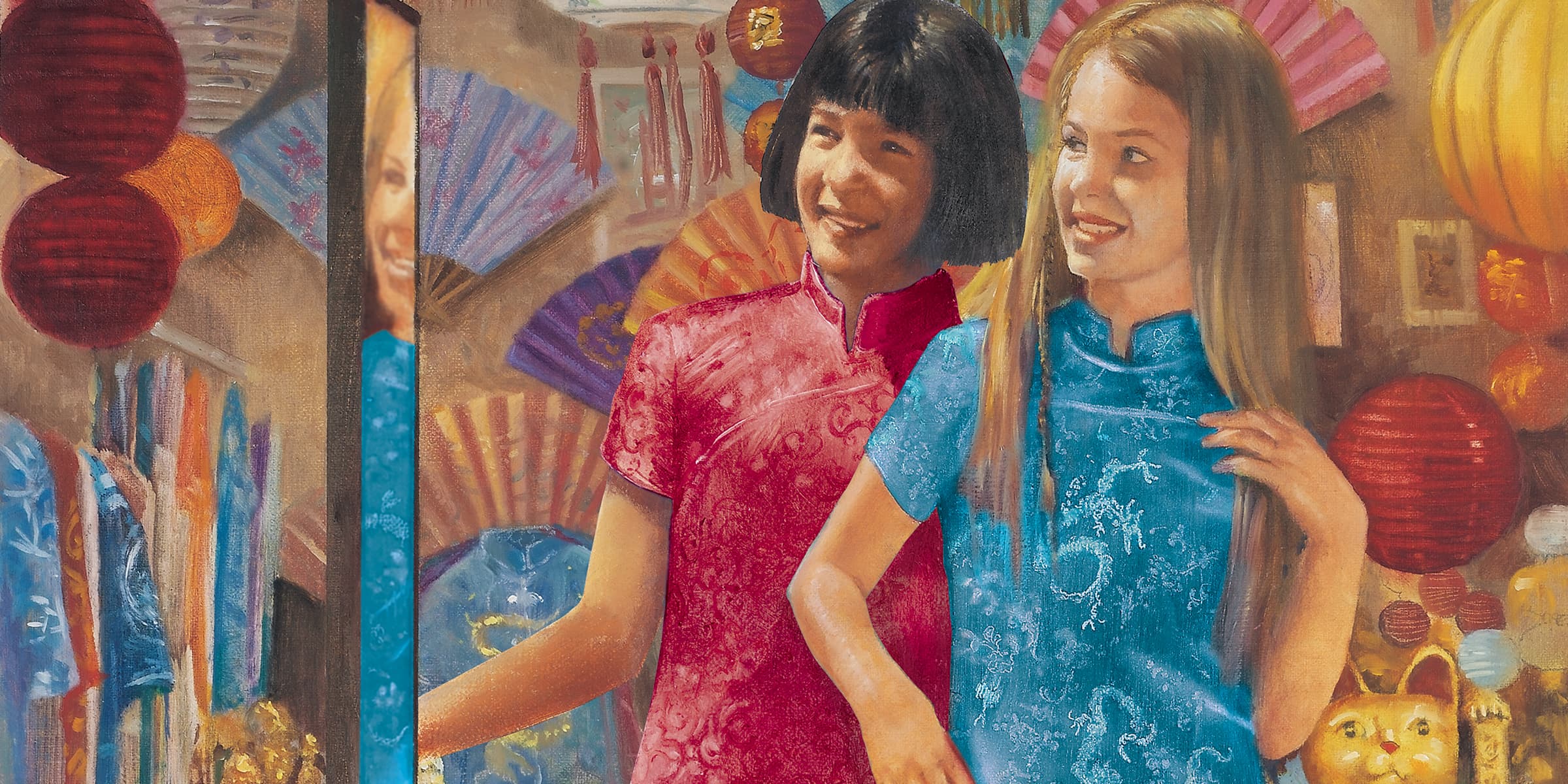
Whether Julie’s fighting for the right to play on the basketball team at school or celebrating Chinese traditions with her best friend, Ivy, inclusivity and cultural awareness are important to her. To help Ivy’s family prepare for Chinese New Year, the girls go with Ivy’s mother to the Chinatown Flower Fair to buy all the flowers and fruits the family will need for the celebration: peach blossoms, peonies, chrysanthemums, Chinese cabbage, wood ear mushrooms, bitter melon, and tangerines. “Look for tangerines that still have stems and leaves attached,” Ivy tells Julie. “That’s for friendship, and staying connected.”
Julie wishes her family felt better connected. When Mrs. Ling invites Julie’s whole family to celebrate Chinese New Year at The Happy Panda, Ivy’s grandparents’ restaurant, Julie is both excited and nervous. Her family hasn’t had much practice being together since the divorce, and Julie’s older sister Tracy has barely spoken to Dad since they moved in with Mom.
At The Happy Panda, Julie’s relieved when Tracy invites Dad to her tennis match, and he happily accepts. And when Julie sees her mom joking with her dad, she’s pleased to see the resilience of her family, and that they can come together in celebration. In the spirit of Chinese New Year, Julie has hope for new beginnings and Gung Hay Fat Choy—good luck and good health in the new year.
Meaningful connections
Bring Julie’s important messages of empathy, resilience, and cultural awareness into your own family by starting educational conversations that spark meaningful connections between you and your daughter:
• People still work to make sure girls and women have the same chances as everyone else, whether that’s at school, in sports, or at work.
• Growing up in a divorced family is still common today, and honoring new ways to be a family is more important than ever.
• When everyone feels included, no matter how they look or where they are from, it makes our communities kinder and stronger for everyone.
• Julie celebrated America’s Bicentennial, or 200th anniversary, in 1976. The year 2026 is America's 250th anniversary. How will we celebrate?

Learn more about Julie’s character and era
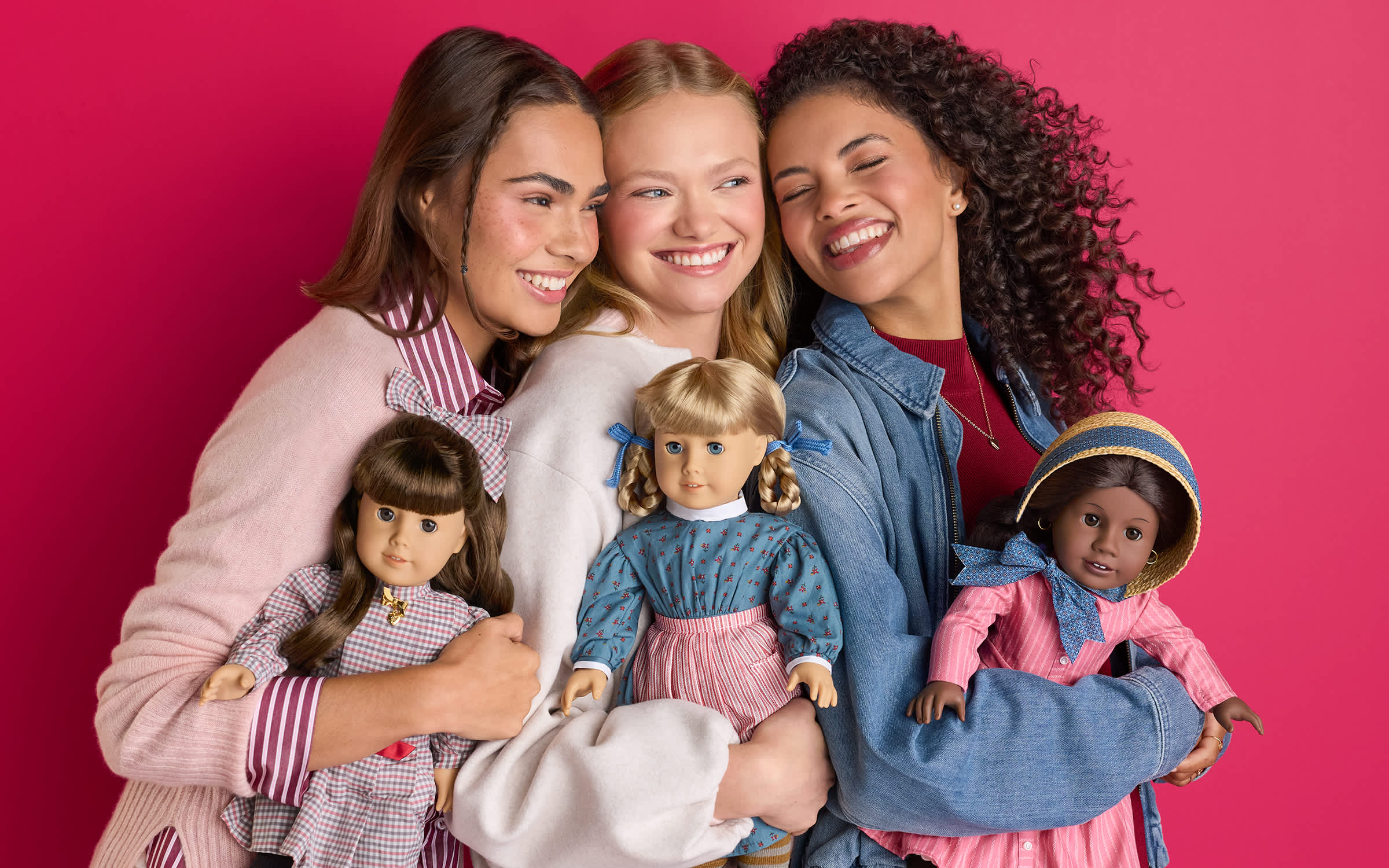
Making a difference today
The most important educational message American Girl teaches girls is that they have their own important stories to tell, and their own ideas to share. American Girl has always believed in putting girls in the center and giving them meaningful representation: stories rooted in courage, resilience, friendship, and the real experiences of girlhood, both past and present. We do our best to create stories that feel authentic, thoughtfully crafted, and designed to help girls understand themselves and the world around them.
There’s educational power in narrative depth, in characters who feel like companions, and in storytelling that empowers girls to see themselves as capable and important. We help girls grow from hopes and dreams to aspirations and ambition, to know that their voices and their view of the world truly matter. We believe passionately that every girl has the power within her to make a difference and change her world for the better.
©2026 American Girl. American Girl and associated trademarks are owned by American Girl, LLC.


